OTD Children

Occupational Therapy Doctorate

Why an OTD?

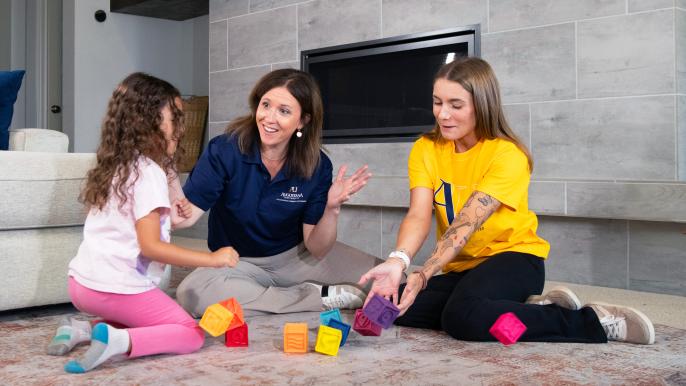
Occupational therapy (OT) is a rehabilitation profession — helping people do the things they want and need to do in their everyday lives. These “occupations” include things, such as work, play, self care, leisure, rest and sleep, social participation, as well as health management and maintenance. Occupational therapy professionals (OTPs) have the opportunity to work with people of all ages, from infants to seniors. 

Augustana University's Occupational Therapy Doctorate (OTD) is an accelerated, hybrid, entry-level or pre-licensure pathway structured to fit the realities of adult life, keeping students connected to the people and places that support them most. The hands-on component of the program, known as Integrated Practice Immersions (IPI), will take place in Bloomington, Minnesota, near the MSP Airport.

Launching in Fall 2026, the Augustana OTD Program has applied for and been granted Candidacy Status by the Accreditation Council for Occupational Therapy Education (ACOTE) of American Occupational Therapy Association (AOTA).
OTD Logo

Contact Us

605.569.8698

Occupational Therapy Doctorate Office of Admission, School of Health Professions


Latest News

Augustana University is embarking on its second doctorate program in three years. The Augustana Occupational Therapy Doctorate (OTD) program, housed within the university’s School of Health Professions, is set to launch in Fall 2026. Augustana’s OTD is an accelerated, hybrid, entry-level or pre-licensure program designed to meet adult learners where they're at in life. The hands-on component of the program, known as lab immersions, will take place in the Twin Cities in Minnesota.

Highlights

Curriculum Design

The Augustana University Occupational Therapy Doctorate (OTD) Program, consisting of six total trimesters, is designed to meet adult learners where they're at in life — allowing them to remain in their own supported environments.

  • The first year of the Augustana OTD Program includes three trimesters or six mini-mesters. Each 8-week minimester will consist of four courses, which include online instruction, as well as 7.5 days of hands-on learning at AU's OTD immersion lab, located in Bloomington, Minnesota — close to Interstate-35 and the Minneapolis-St. Paul (MSP) International Airport.
  • Students complete 24 weeks of fieldwork and a 14-week Capstone during the second year of the program. 
  • While not a requirement of the program, Augustana is developing additional fieldwork experiences for OTD students. The university is working with Augustana's De & Dave Knudson Center for Global Engagement and Therapy Abroad to offer students hands-on learning opportunities internationally in Belize or Dominica.
Augustana University OTD Program 
Six Trimesters | 100 Credit Hours
YEAR ONE | THREE TRIMESTERS OR SIX MINIMESTERS

TRIMESTER

TRIMESTER

TRIMESTER

MINIMESTER

MINIMESTER

MINIMESTER

MINIMESTER

MINIMESTER

MINIMESTER

Eight Weeks | Four Courses

Online Instruction &
7.5 Days of Lab Immersion in Twin Cities — Minnesota

Eight Weeks | Four Courses

Online Instruction &
7.5 Days of Lab Immersion in Twin Cities — Minnesota

Eight Weeks | Four Courses

Online Instruction &
7.5 Days of Lab Immersion in Twin Cities — Minnesota

Eight Weeks | Four Courses

Online Instruction &
7.5 Days of Lab Immersion in Twin Cities — Minnesota

Eight Weeks | Four Courses

Online Instruction &
7.5 Days of Lab Immersion in Twin Cities — Minnesota

Eight Weeks | Four Courses

Online Instruction &
7.5 Days of Lab Immersion in Twin Cities — Minnesota

YEAR TWO | THREE TRIMESTERS

     TRIMESTER

      TRIMESTER

 TRIMESTER

12 Weeks | Fieldwork

12 Weeks | Fieldwork

14 Weeks | Capstone

OTD graduates must pass the national certification exam — the National Board for Certification in. Occupational Therapy (NBCOT) Exam — to practice in the United States.

Careers

Career opportunities for Augustana OTD Program graduates span health care, education, community-based organizations and emerging areas of practice where graduates help individuals and populations engage in the occupations that give life meaning and purpose. Through leadership, advocacy, scholarship and clinical practice, graduates are equipped to serve others and address evolving societal needs.