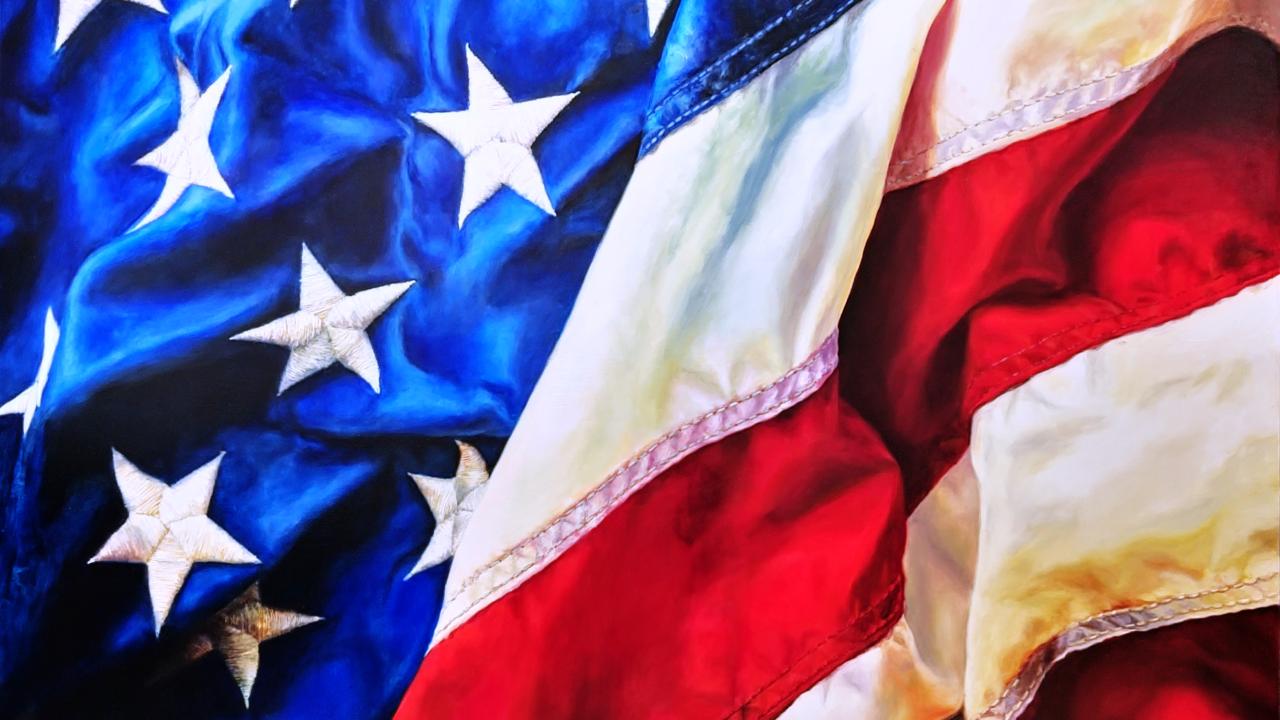
Pictured Above: Detail of "A More Perfect Union" by Susan Hartenhoff Haygood
Still Becoming: America at 250
The Center for Western Studies is excited to present "Still Becoming: America at 250." We invite you into our galleries to reflect on our nation’s past, present and future through the work of 22 regional artists.
The artists in this exhibition offer a variety of perspectives on what America means today. Some works celebrate the beauty of our landscapes and communities, while others explore identity, history, culture, and the experiences that continue to shape our country. Together, they remind us that America's story is not finished.
There is no single way to define America, and there is no single story to tell. Through painting, photography, and mixed media, these artists encourage us to reflect, ask questions, and engage in conversations about where we have been and where we are going.
We invite you to help us commemorate America’s 250th anniversary, and we hope this exhibition offers an opportunity to pause, reflect, and consider what it means to be a part of a nation that is, in many ways, still becoming.
“Still Becoming” will be on display from Monday, June 29, through Friday, October 16, in the Madsen, Nelson and Elmen Galleries of the Center’s Fantle Building at 2121 S. Summit Avenue in Sioux Falls. An artist reception will be held Thursday, July 16, from 6:30-8 p.m.
Gallery hours are Monday through Friday, from 8 a.m. to 5 p.m. The exhibition is free and open to the public.
The CWS has several display cases throughout the galleries that exhibit materials on a variety of changing themes. The current exhibits are:
Native Reflections on America's 250th
Although framed as a celebration, the United States Bicentennial in 1976 carried very different meaning for Native American communities. After 200 years of broken treaties, land dispossession, and forced assimilation, they viewed American history through the lens of colonization. Fifty years later, we’ve asked Native American scholars and artists connected to CWS to share what the 250th anniversary means to them. Acknowledging the complexity of our fellow citizens’ experiences, their thoughts are displayed together with historical Native American artifacts featuring flag iconography from the center’s collections.
Building Skills, Building America: Life in the Civilian Conservation Corps, South Dakota, 1933-1942
This exhibit by intern Lauren Murphy explores the impact of the Civilian Conservation Corps (CCC) in South Dakota from 1933 to 1942, highlighting how the program provided structure, education, and economic support to 30,000 young men during the Great Depression while transforming the state’s landscape through conservation and infrastructure projects. During this commemorative anniversary, the CCC reflects a powerful moment of federal and local cooperation in American history, demonstrating how national investment in public service strengthened both communities and individual opportunity, creating an enduring legacy still visible across South Dakota today.
One Nation under God: Indigenous Assimilation in St. Mary's Episcopal School for Indian Girls
Operating from 1884 to 1986, St. Mary’s Episcopal School for Indian Girls was one of several Native American boarding schools in South Dakota. Established to integrate Native children into American society and convert them to Christianity, the legacy of St. Mary’s is complicated. In exploring the school's history, this exhibit by intern Catherine Banson reflects the complex legacies that have shaped the country's foundations, including its Christian roots.
Groton Rum Drum: A Revolutionary War Keepsake
With our Northern Plains focus, the Center for Western Studies has limited connections to the Revolutionary War. But America’s 250th anniversary is a unique opportunity to display the lone Revolutionary War artifact in the center’s collections: a rum ration barrel carried by Massachusetts soldier Joshua Parker. This display by intern Catherine Banson explores the Continental Army’s use of spirits, and the important role rum played in the trans-Atlantic slave trade.
Jennie Berdahl's Wedding Dress
Together with interpretive text by intern PattyJo English, the dress Jennie Berdahl wore when she married author Ole E. Rolvaag in 1908 is now on exhibit. Rolvaag and Berdahl met while students in the academy division of Augustana College in Canton, South Dakota, graduating in 1901 and 1903, respectively. Rolvaag continued his studies at St. Olaf College but maintained correspondence with Berdahl and proposed to her in 1903. For many years, the dress was displayed in the Berdahl-Rolvaag House, one of the buildings comprising Heritage Park, managed by the Nordland Heritage Foundation. The dress was one of several items CWS staff selected for transfer to the center’s collections when Heritage Park closed in 2022.